Sunday, June 7, 2015

The Ocelot (Kristen Forster)

The Ocelot
Report by: Kristen Forster
Bio 227-01


The Ocelot (Leopardus pardalis) was added to the endangered species list in 1972 under the authority of the Endangered Species Conservation Act of 1969. The Ocelot is listed as endangered in Arizona and Texas.  If efforts are cordially met and carried out in the prescribed recovery plan the Ocelot's down listing could potentially be met by 2030.

Species Description and Ecology 
The Ocelot have magnificent striped and spotted markings. The fur may be anywhere from a pale cream to a reddish gray with open centered spots that run the length of the body like links in a chain. The underside a is bright white with tiny black spots and stripes. These markings allow it to blend perfectly with its surroundings. The spotted and stripped markings on every ocelots are different, no two felines are the same. (http://www.felineconservation.org/feline_species/ocelot.htm)

Ocelots mate one a year and birth a litter ranging from 1-2 kittens. At around month 3, these newborn kittens accompany their mothers on their first hunting trip and remain by their mothers side they are one years old.

http://www.reddit.com/r/Ocelotkittens/

Geographic and Population Changes
Ocelots are typically known to be found in Central American but can also located in Texas, Arizona, and Northern Argentina. These felines are found in a variety of habitats including but not limited to: tropical forests, Savannah grasslands, mangrove forests and marshes, and scrub regions. (http://animaldiversity.org/accounts/Leopardus_pardalis/

http://www.defenders.org/ocelot/basic-facts
The population for the Ocelots has fluctuated throughout the years but now, the populations that "Tewes and Everett (1986) provided “a crude estimate” of 80-120 individuals in Texas based on distribution of radio-tagged ocelots extrapolated to areas that were probably suitable habitat." (http://ecos.fws.gov/docs/recovery_plan/100826.pdf). There are estimated to be fewer than 100 Ocelots left in the United States, and with numbers dwindling this quickly it is important to do everything we can to try to save the Ocelot.

Listing Date and Type of Listing
The Ocelot was added to the Endangered Species list on March 28, 1972 as an Endangered Species. These felines are listed in the Southwest Region (Region 2) which includes Arizona, New Mexico, Texas, and Oklahoma. (http://ecos.fws.gov/speciesProfile/profile/speciesProfile.action?spcode=A084)

Cause of Listing and Main Threat to Current Existence
Initially, the main threat to the Ocelot's current existence is the human population. With habitat loss, automobile collisions, and inbreeding the population is continually decreasing. However, these threats were not the only factors that enabled the Ocelot's movement towards the endangered species list. According to the Ocelot Recovery Plan implemented by the U.S. Wildlife Fish and Game Services the main reason the Ocelot's were listed are as followed:
-Factor A: The present or threatened destruction, modification, or curtailment of its habitat or range.
-Factor B: Over-utilization for commercial, recreational, scientific, or educational purposes.
-Factor C:  Disease or predation.
-Factor D: The inadequacy of existing regulatory mechanisms.
-Factor E:  Other natural or anthropogenic factors affecting its continued existence.
http://notalotofocelots.weebly.com
http://jaguardetectives.wildlifedirect.org/
(http://ecos.fws.gov/docs/recovery_plan/100826.pdf)

Description of Recovery Plan
The key components to the Ocelot's recovery plan are as followed (using Factors listed above):
1) Assess, protect, and restore sufficient habitat to support viable populations of the ocelot in the borderlands of the United States and Mexico (Listing Factor A). 
2) Reduce the effects of human population growth and development on ocelot survival and mortality (Listing Factors A,E). 
3) Maintain or improve genetic fitness, demographic conditions, and health of the ocelot (Listing Factors C,E). 
4) Assure the long-term viability of ocelot conservation through partnerships, the development and application of incentives for landowners, application of existing regulations, and public education and outreach (Listing Factors A,D,E). 
5) Practice adaptive management in which recovery is monitored and recovery tasks are revised by the USFWS in coordination with the Recovery Team as new information becomes available. 
6) Support international efforts to ascertain the status of and conserve the ocelot south of Tamaulipas and in Sonora (Listing Factors A,B,C,D,E). (http://ecos.fws.gov/docs/recovery_plan/100826.pdf)

The long-term goal for the Ocelot Recovery Plan implemented by the U.S. Fish and Wildlife Service is to try and recover the Ocelot's population by the year 2030 so it is healthy and once again stable. 

For more information on the Ocelot, please go to (http://ecos.fws.gov/docs/recovery_plan/100826.pdf) for the entire recovery plan. 


Friday, June 5, 2015

The Hopeful Recovery of the Endangered Blue Whale by Drew Fredrickson

By: Drew Fredrickson


The Blue Whale 
Source: bluewhales.org


The Blue Whale was listed as endangered under the Endangered Species Act in 1998 on July 28. The recovery plan for the Blue Whale is currently in its final stage. 


Species Description and Ecology:
   The Blue Whale is the largest animal ever known to have lived on Earth. Adults in the Arctic have reached a maximum body length of about 33m & can weigh more than 150,000kg. They are long-bodied and slender and their skin is a lightly mottled blue-grey with light grey or yellow-white undersides.  http://ecos.fws.gov/docs/recovery_plan/whale_blue.pdf

   Like many other baleen whales, it feeds in cool waters at high latitudes, and generally migrates to warmer temperate and tropical waters to breed and give birth, although in some areas it appears that the species may be resident year-round. 

FUN FACTS
  • The blue whale's heartbeat can be detected from two miles away and its heart is the size of a Volkswagen Beetle. 
  • Its stomach can hold one ton of krill and it needs to eat about four tons of krill each day.
  •  It is identified by a relatively small dorsal fin, a fairly rounded rostrum (anterior part of the skull), and approximately 90 ventral grooves which reach the navel. 
http://wwf.panda.org/what_we_do/endangered_species/cetaceans/about/blue_whale/


Source: https://milesandhisfavorites.wordpress.com/virtual-classroom/field-trip-adventure-two-under-the-ocean/
Geographic and Population Changes:
    The blue whale has a truly global distribution, occurring in the Arctic Sea, Atlantic Ocean , Indian Ocean, and Pacific Ocean. In spite of their global distribution, they are one of the rarest of the whales, and most biologists consider them to be among the most endangered of the great whales. Only one population, in the eastern North Pacific off California, is showing real recovery and currently numbers about 2,000 animals.  http://wwf.panda.org/what_we_do/endangered_species/cetaceans/about/blue_whale/

Blue Whale Range
Source:http://en.wikipedia.org/wiki/Blue_whale
  It is assumed that blue whale distribution is governed largely by food requirements and that populations are seasonally migratory.  Poleward movements in spring allow the whales to take advantage of high zooplankton production in summer. Movement toward the subtropics in the fall allows blue whales to reduce their energy expenditure while fasting, avoid ice entrapment in some areas, and engage in reproductive activities in warmer waters of lower latitudes.  Before the whaling industry went global, blue whale population included more than 270,000 individuals. Currently it is believed that about 10,000 blue whales are left in the world. http://www.bluewhales.org/category/blue-whales

Cause of Listing and Main Threats to Current Existence:
   From the turn of the century until the mid-1960’s, blue whales from various stocks were intensively hunted in all the world’s oceans, reducing the population to the point of being put on the Endangered Species List. Hunting, pollution and environmental degradation are considered to be the most important causes why blue whales are endangered. http://www.bluewhales.org/category/blue-whales
The official Recovery Plan created for the conservation of Blue Whales states the main threats to the species existence as:
  • Vessel interactions
    • 1) Collisions with ships: are occasionally injured or killed by ship collisions
    •  2) Disturbance by vessels: there is concern that persistent close approaches by tour boats have a negative effect on the whales; under the Canadian Fisheries Act it is illegal to “disturb” whales.
  • Entrapment and Entanglement in Fishing Gear:
    • A few whales have been found to be killed from the effects of entanglement in fishing gear.
  • Habitat degradation:
    • Some of the areas used by blue whales have been degraded by acoustic and chemical pollution.
  • Hunting:
    • Deliberate killing has had a severe effect on the status of blue whales in the North Atlantic; at least 11,000 were taken from the late 19th to mid 20th century.
http://ecos.fws.gov/docs/recovery_plan/whale_blue.pdf


 Recovery Plan:
  The key recommended actions of the proposed recovery program for the Blue Whale are to:
1) Determine population structure of blue whales, 
2) Estimate population size and monitor trends in abundance, 
3) Identify and protect essential habitats, 
4) Minimize or eliminate human-caused injury and mortality, 
5) Coordinate state, federal, and international actions to implement recovery efforts, 
6) Determine and minimize any detrimental effects of directed vessel and aircraft interactions, and 
7) Maximize efforts to acquire scientific information from dead, stranded, and entangled animals. 

The overall long-range goal of this Recovery Plan is to promote recovery of blue whale populations to levels where it will become appropriate to downcast them from endangered to threatened status, and to ultimately remove them from the list of Endangered and Threatened Wildlife under the ESA. 
http://ecos.fws.gov/docs/recovery_plan/whale_blue.pdf


Want more information on the Blue Whale?
 Sources used:
http://ecos.fws.gov/docs/recovery_plan/whale_blue.pdf
http://www.bluewhales.org/category/blue-whales


http://wwf.panda.org/what_we_do/endangered_species/cetaceans/about/blue_whale/

EXTRAS: 

Go to http://animals.nationalgeographic.com/animals/blue-whale-interactive/ to learn more about the Blue Whale through a fun interactive experience! 

Visit http://www.worldwildlife.org/species/blue-whale to learn how you can help save the Blue Whales and even adopt one! 


Ivory-Billed Woodpecker by Amy Gunn

The Ivory Billed Woodpecker (campephilus principalis) was listed as endangered on March 11th 1967. The species was thought to be extinct, until 2005 when birders spotted the species in an Arkansas swamp forest. According to National Geographic, "It was hailed as the bird equivalent of finding Elvis alive." This video, with the link below, was featured on cbsnews.com and describes the event where the species was rediscovered and how significant this discovery was. 


The ivory-billed woodpecker is known to be found in the southeast region, specifically in Arkansas. It's known for its striking black and white plumage. It has a robust white chisel tipped bill. It has has a lemon yellow eye and a pointed crest. 
The male ivory-billed woodpeckers are red from the nape to the top of their crest, while the female woodpeckers have a solid black crest. In the picture, the male is shown above with the female below.

The overall length of the ivory-billed woodpecker is approximately 48-51 cm, a wingspan of 76-80 cm and a weight of 454-567 grams. 

This species is a resident of large, contiguous forests with numerous trees and part of the forest in decay to provide the species a continuous supply of food. 


The diet of this species is not well understood. Large beetle larvae is considered the most important component of its diet with also members of the long horned beetle family noted to be found in their stomachs. The ivory-billed woodpeckers have a greater home range in comparison to other smaller woodpeckers. They fly distances of at least several kilometers each day to get from their roost sites to feeding areas. As far as reproduction goes, breeding for this species occurs between January and April. It as clutch sizes of 2 to 4 eggs. Both sexes of this species incubate the eggs and both parents help feed the young for about  35 days until they are ready to go on their own. Below is a picture of a baby ivory-billed woodpecker. 


The greatest known threats to the ivory-billed woodpecker include logging, mining, plantations and other various types of exploitation. It's thought that logging of the mature forests that form its habitat was probably the major cause for the disappearance of the species. 

The Recovery Plan for the ivory-billed woodpecker was enacted in April of 2010 in response to the new sightings of the species in Arkansas. 
1) The recovery strategy is to focus first on locating and confirming the presence of the species, and then to add to the knowledge about the woodpecker. 
2)The goal of the recovery plan is to locate, protect and increase existing populations and associated habitats so it can be down listed from the endangered species list to the threatened species list.
3) The recovery objectives include: identify and delineate any existing populations, identify and reduce risks to any existing population, protect and enhance suitable habitat, and lastly reduce or eliminate threats to allow restoration of multiple populations
 4)In order for the recovery goal to be achieved, there are certain criteria to be followed, this includes: surveying any potential habitats for any occurrences of the species, determining the current habitat use and needs of existing populations, conservation of habitats on public and private lands, analyzing viability of existing populations, and determining the number and geographic distribution of subpopulations needed for a self-sustaining metapopulation. 
5)Recovery actions that must be taken in order for the recovery plan to be implemented correctly include: population surveys and monitoring, habitat inventory, population and habitat modeling, research for testing biological assumptions, landscape characterization and assessment, outreach and education on conservation of species, management of public use where species is, and the management of rediscovered population. 


The total estimated cost of recovery for the ivory-billed woodpecker is unfortunately unknown. This is due to the limited knowledge about its occurrence, distribution, and long term actions. 

For more information, videos, and fun facts about the ivory-billed woodpecker, visit the website below. 


Works Cited: 


Digital image. Http://upload.wikimedia.org/wikipedia/commons/e/e8/Campephilus_principalisAPP049CA.jpg. Web.

Digital image. Http://osaconservation.org/wp-content/uploads/2010/09/Dahl_Pale-billed-Woodpecker-Watermark.jpg. Web.

Digital image. Http://sdakotabirds.com/species/maps/ivory_billed_woodpecker_map_large.jpg. Web.

Digital image. Http://www.gambassa.com/gambassafiles/images/images/averyl/ivory_billed_woodpecker_v1.jpg. Web.

"Finding The 'Lord God Bird'" CBSNews. CBS Interactive. Web. 5 June 2015. <http://www.cbsnews.com/news/finding-the-lord-god-bird/>.

"Ivory-Billed Woodpeckers, Ivory-Billed Woodpecker Pictures, Ivory-Billed Woodpecker Facts - National Geographic." National Geographic. Web. 5 June 2015. 
<http://animals.nationalgeographic.com/animals/birds/ivory-billed-woodpecker/>.

"Ivory-billed Woodpecker." , Life History, All About Birds. Web. 5 June 2015. <http://www.allaboutbirds.org/guide/Ivory-billed_Woodpecker/lifehistory>.

"Ivory-billed Woodpecker Photos and Facts." Ivory-billed Woodpecker Videos, Photos and Facts. Web. 5 June 2015. <http://www.arkive.org/ivory-billed-woodpecker/campephilus-principalis/>.

"Recovery Plans Search." Endangered Species. Web. 5 June 2015. <http://www.fws.gov/endangered/species/recovery-plans.html>.


Tuesday, June 2, 2015

Mariana Crow Recovery (David Gordon)

 
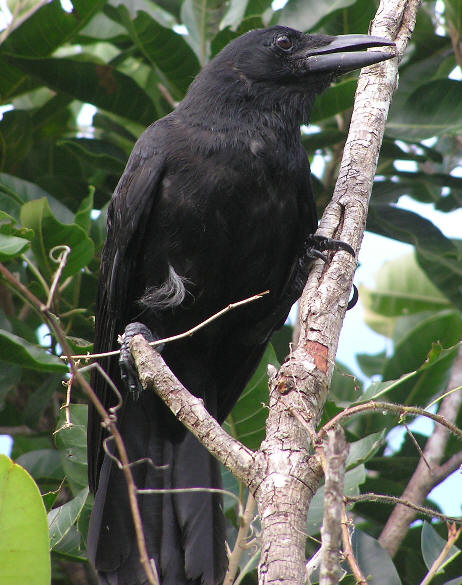
The mariana crow, also known as the Aga Crow (Corvus kubaryi), were originally found in Guam and Rota, however the last native crow from Guam is believed to have vanished in the early 2000’s. The crow tends to live in mature limestone forest, but can also be found around coastline, ravine, and agricultural forests as well as coconut plantations. 
Mariana Crow on Rota

This bird nests in the drier season, from September to March. The construction of their nest resembles a large platform supporting smaller “cups” made from sticks and vines found throughout the forest. Their nests have only been found in trees native to Guam and Rota. Mariana crows typically eat small invertebrates and fruit as their diet. 
Mariana crow chicks - Photo credit Mike Lusk/USFWS

As of May 2005, Ten crows are known to survive in the wild on Guam, however all of the individuals are known to have originated from Rota. As far as populations on Rota, there were believed to be 85 pairs of crows but with expectations for this number to decline.
Brown Tree Snake
The priority number for recovery for the Mariana Crow is 5C. This is measured on a scale of 1 to 18. This rating was found based on the fact that the Mariana Crow faces a “high degree of threat, low potential for recovery, and high potential for conflict with human activities (U.S. Fish and Wildlife Services).” The species was listed as endangered on January 11, 2006. In 2008 the species was reclassified as Critically Endangered. 

The reason for listing was a result of many external factors working against the Mariana Crow as a species. Habitat loss played a large role, however it was also accompanied by human persecution, diseases from introduced species like cats and rats, as well as nutritional factors. The leading cause however is believed to be the brown tree snake that was introduced to Guam. Rats are blamed as the leading cause for the eradication of this species on Rota. The main continued threats are the tree snake and predation from other species such as rats and cats. 

The current plan in action to help the species recover consists of several actions that need to be taken. The main priority is to reduce the number of tree snakes that are present in the habitats of the mariana crow. The second priority is to protect and conserve the habitats that Mariana crows can be found within. The 3rd and final main recovery action plan is to begin detailed research on the species so as to better monitor its numbers and condition in the future. The estimated date of recovery, assuming that all goes well and the species begins to heal according to the action plan, is in the year of 2055. 


Works Cited:

"Rota Avian Behavioral Ecology Program." The Birds. University of Washington, n.d. Web. 28 May 2015.

U.S. Fish and Wildlife Service. 2005. Draft Revised Recovery Plan for the Aga or Mariana Crow, Corvus kubaryi. Portland, Oregon. x + 147 pp.

Photo Citations in Order of Appearance:

"Rota Avian Behavioral Ecology Program." The Birds. N.p., n.d. Web. 02 June 2015.

"Mariana Crow - Pacific Islands Fish and Wildlife Office." Mariana Crow - Pacific Islands Fish and Wildlife Office. N.p., n.d. Web. 01 June 2015.

"THE REPTILES OF AUSTRALIA." BROWN TREE SNAKE Night Tiger Boiga Irregularis. N.p., n.d. Web. 02 June 2015.